Due to changing consumer habits and anti-plastic legislation, WOOPAK® faces growing demand for sustainable packaging solutions that can replace traditional plastic packaging for pillows and quilts. It is not always easy to know which material is the best option.
Choosing the right material is not black and white. It depends on the packaging objectives and on the context in which the packaging will be used.
Before choosing a material, it is useful to ask the following questions:
- Is the packaging meant to be reused or recycled?
- If it is reused, how many times should it last? Should it be washable?
- If it is recycled, in which recycling stream? Is this stream operational in the target market?
- Will the packaging be carried a lot and should it be lightweight?
- Does the packaging need a high level of customisation?
Here is a guide to the main options we offer at WOOPAK® for more sustainable quilt packaging and pillow packaging, with their advantages and disadvantages.
Natural materials for pillow and quilt bags
Organic cotton: a preferred solution for intensive reuse and premium packaging
In eco-responsible packaging, cotton bags are popular with consumers because of their natural and robust appearance. Cotton is the most used textile fibre in the world and has a vast industrial sector. It is also soft and flexible, which suits a quilt and pillow bag designed to evoke comfort.
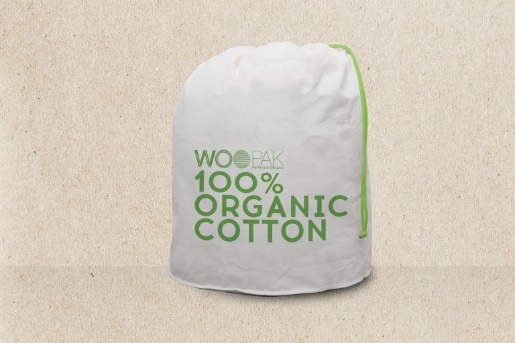
A cotton packaging has the following advantages:
- Plant-based and renewable raw material.
- Resistant and reusable for life.
- Machine washable.
- Premium appearance.
- Breathable.
- Recyclable.
However, cotton growing consumes a lot of water. The sector represents only a small share of cultivated land, but a significant share of pesticides used on farms. Washing pesticide-soaked fibres also discharges wastewater and increases the water footprint of conventional cotton.
At WOOPAK®, we choose organic cotton for quilt and pillow bags to limit the counterproductive impacts associated with traditional cotton.
The disadvantages of cotton packaging are its higher price, especially for organic cotton, its water-intensive cultivation, its relative transport weight and the need for a dedicated textile collection stream to be recycled.
Organic cotton packaging is therefore recommended for premium packaging with high durability and reusability. Its ecological benefit is easily perceived by consumers.
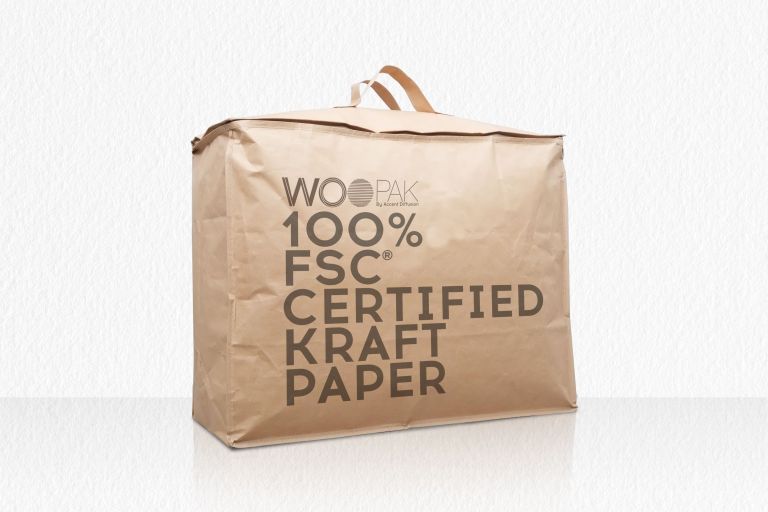
Kraft paper: a sustainable solution with good value for money
Kraft packaging is widely used as an alternative to traditional plastic packaging for pillows and quilts. It has interesting ecological properties and remains competitive compared with other ecological solutions, which makes it suitable for large-scale markets.
Kraft is produced from wood pulp. Its production consumes energy, but far less water than cotton: approximately 500 litres of water are required to produce 1 kg of kraft paper, compared with about 10,000 litres for traditional cotton.
At end of life, kraft paper can be composted or recycled in the paper and cardboard stream. It is also resistant enough to be reused before recycling.
A kraft paper packaging has the following advantages:
- Plant-based and renewable origin.
- Easily recyclable.
- Biodegradable.
- Good value for money.
- Perceived as environmentally friendly by consumers.
- Much less water-intensive than cotton.
Nevertheless, kraft production can contribute to deforestation if the raw material is not controlled. This is why WOOPAK® selects FSC®-certified kraft and a resistant quality designed to encourage reuse. We offer it in its raw brown, unbleached form to limit processing that could harm its ecological properties.
Its disadvantages are that it is less compact than plastic, can crease easily, is not water resistant, offers less colour customisation and is generally reused less often by consumers than cotton or plastic packaging.
FSC® kraft quilt and pillow bags therefore offer many ecological advantages over plastic packaging. Their attractive price-quality ratio makes kraft a strong option for large-scale deployment.
Paptic®: a unique combination of paper, textile and plastic properties
Paptic® is an innovative material well suited to eco-responsible duvet and pillow packaging. It combines the ecological properties and hand-feel of paper with strength and flexibility close to fabric or plastic.
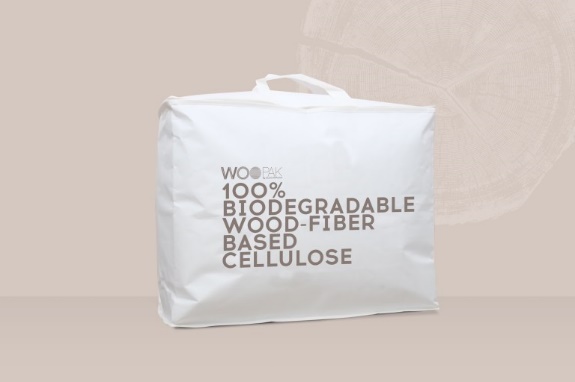
This FSC®-certified, plant-based material is made from wood fibres sourced from sustainably managed forests. It can be produced on the same machines used to produce paper, without requiring new manufacturing machinery.
Paptic® offers renewable raw material, recyclability in the paperboard stream, biodegradability, European manufacturing, a soft hand-feel, higher resistance than kraft paper, fewer wrinkles and a production approach that considers water and energy resources.
Its soft touch and white colour evoke the softness of the duvets and pillows it protects. At WOOPAK®, we were the first to offer this material to the bedding packaging market in Europe, and we believe it is a real game changer for sustainable packaging.
Its main disadvantages are that it is heavier and less compact than plastic for transport, and that its lifetime is shorter than cotton or plastic packaging.
Plastic material: the choice of recycled PET
Recycled PET is made from 100% recycled water bottles. The rPET used by WOOPAK® is post-consumer and GRS certified. It can be used as a non-woven or woven material and is itself recyclable.
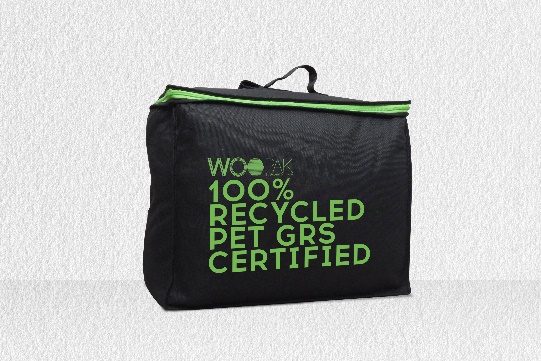
rPET has physical properties close to PET. It is versatile, tear-resistant, water-resistant, available in many colours, weights and weaves, and gives a second life to non-biodegradable materials. Recycled PET also uses significantly less energy than virgin PET.
Its main drawbacks concern end of life: it decomposes very slowly if discarded in nature, it remains a plastic originally derived from petroleum, it is more expensive than regular PET, and consumers must understand that it is recycled material rather than conventional plastic.
Nevertheless, rPET remains a good solution when the objective is to preserve the technical properties of a conventional plastic bag while moving toward greener packaging.
Once the main material is chosen, components and design matter too
The eco-design of a bag also lies in the details: components, zips, yarns, trims and construction. WOOPAK® supports brands in designing customised eco-responsible products, including recycled zips and cellulosic yarns where relevant.
Our core value is innovation and the desire to stay one step ahead in bedding packaging eco-conception. We constantly look for new solutions to create the eco-responsible packaging of tomorrow.